The School’s objectives
The school of Beaux-Arts de Paris is both a centre for training and artistic experimentation, exhibitions and the curation of historical and contemporary collections, and a publishing house. As the successor to the Royal Academies of Painting and Sculpture founded in the 17th century during the reign of Louis XIV, the École nationale supérieure des beaux-arts, which operates under the supervision of the Ministry of Culture, has as its primary aim the training of artists of the highest calibre. It plays a vital role in the contemporary art scene.
In keeping with the educational principles that have always been upheld at the Beaux-Arts de Paris, teaching takes place in studios under the guidance of renowned artists. This studio-based practice is complemented by a range of theoretical and technical courses designed to provide students with a variety of approaches. These aim to equip them with a broad artistic education, whilst encouraging experimentation across multiple fields and fostering interdisciplinary work.
The variety of knowledge and disciplines encountered at the School opens up a wide range of possibilities that can be explored throughout the course. This programme, in which every student can draw on the resources needed to underpin their own personal artistic approach, is designed to enable each student to understand the challenges facing contemporary art and the status of the artist today.
The École des Beaux-Arts de Paris, firmly rooted in economic and social reality, is also committed to building bridges between student life and professional life, in particular by introducing its students to the art world and facilitating encounters with key figures within it. This is why the communications department publicises, throughout the year, announcements regarding scholarships, awards, residency opportunities and calls for proposals in which students can take part. Some of these opportunities are directly linked to the School’s patronage and partnership policy. Throughout their studies, students thus see a growing number of opportunities to contribute to projects and showcase their work to a wide audience.
In particular, the Beaux-Arts de Paris has developed the SACRe (Science, Art, Creation, Research) research programme in collaboration with five of its member institutions (CNSAD, CNSMD, Fémis, EnsAD and ENS).
Saint-Germain-des-Prés and Saint-Ouen
Beaux-Arts de Paris is located on two sites.
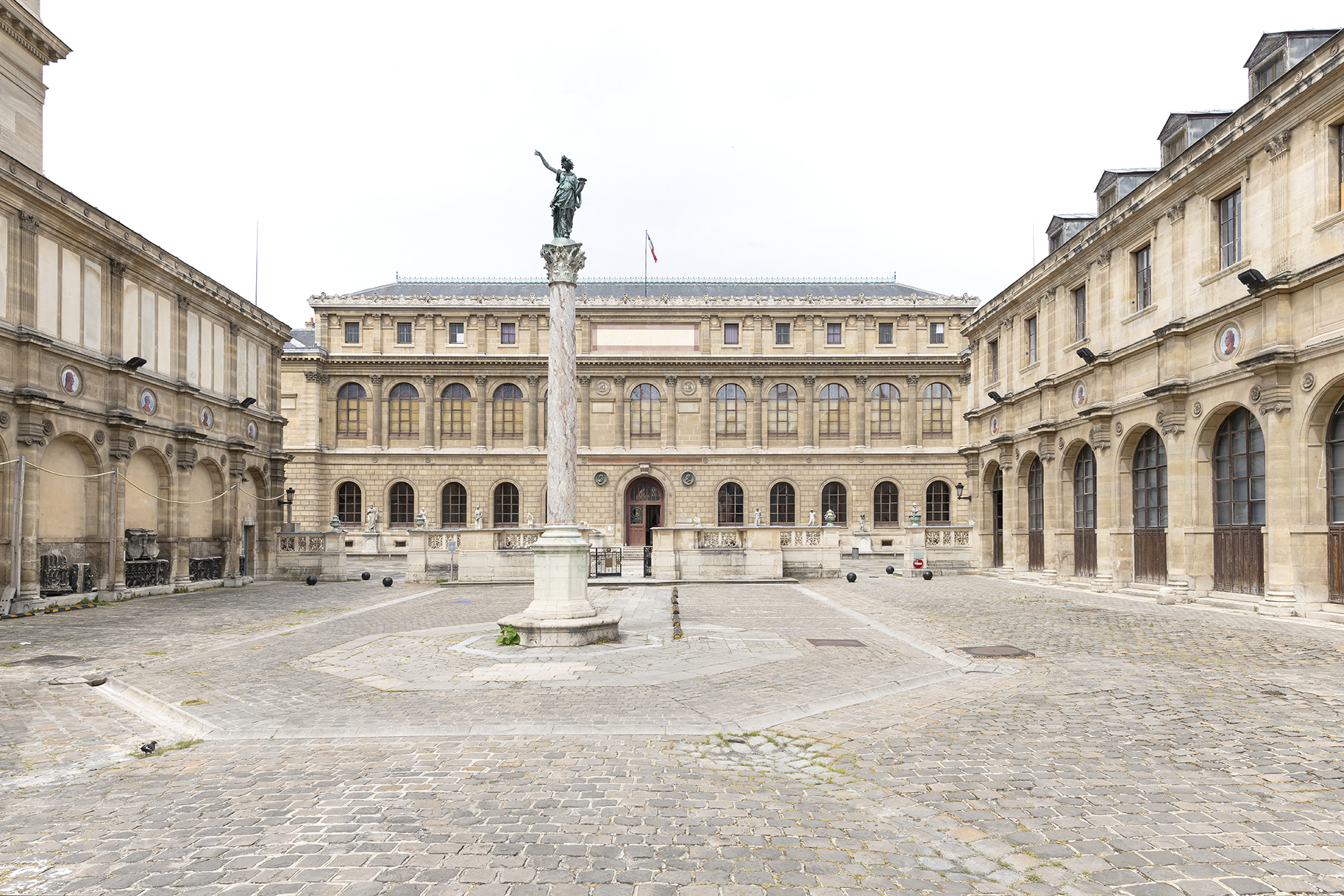
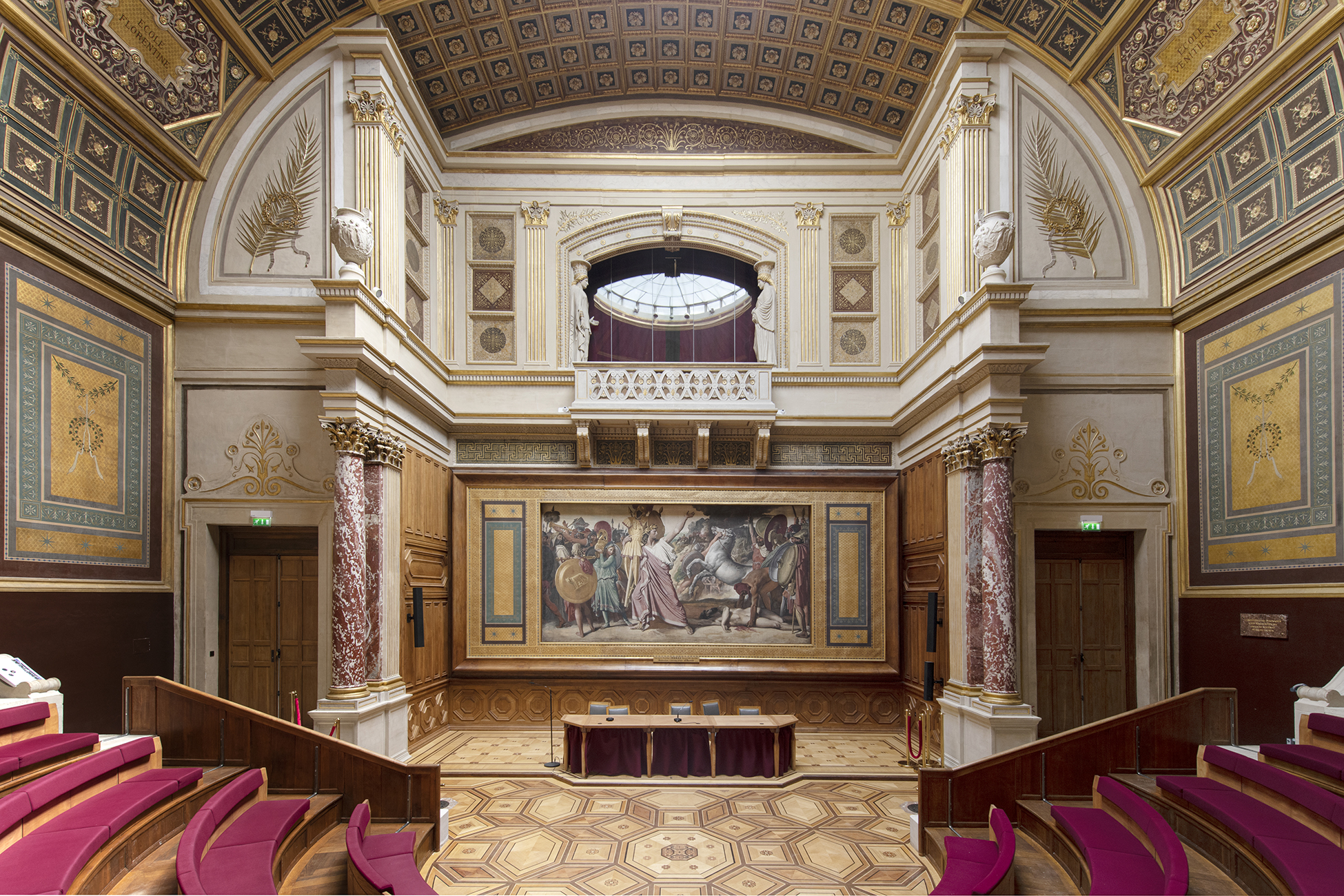
The institution, situated in Saint-Germain-des-Prés, covers an area of two hectares. It comprises numerous studios, as well as three lecture theatres and a morphology studio dedicated to drawing, a library specialising in contemporary art, and two exhibition spaces: the Palais des Beaux-Arts and the Cabinet des Dessins et Estampes – Jean Bonna.
The École des Beaux-Arts de Paris has a second site in Saint-Ouen-sur-Seine. A vast space, situated in the Puces district, houses the studios and workshops for carving, modelling, casting, metalwork, composite materials and ceramics. Housed in a former industrial building covering 1,000 m², the site enables the development of large-scale projects. It also hosts the public preparatory class, which opened in 2016. Via Ferrata welcomes fifty students from secondary schools in priority areas who wish to prepare for the entrance examinations to art schools.
History of the buildings
The École des Beaux-Arts in Paris comprises a vast architectural complex whose buildings, situated between Rue Bonaparte and Quai Malaquais, date from the 17th, 18th, 19th and 20th centuries. The institution traces its origins to the Royal Academy of Painting and Sculpture, founded by Anne of Austria in 1648, and the Royal Academy of Architecture, established by Louis XIV in 1671, both of which were dissolved by the Convention in 1793. From 1797 onwards, the two institutions merged into a single body, giving rise to the École des Beaux-Arts. This was successively housed at the Louvre, then at the Institut de France, and finally on the site of the former Petits-Augustins convent on Rue Bonaparte.
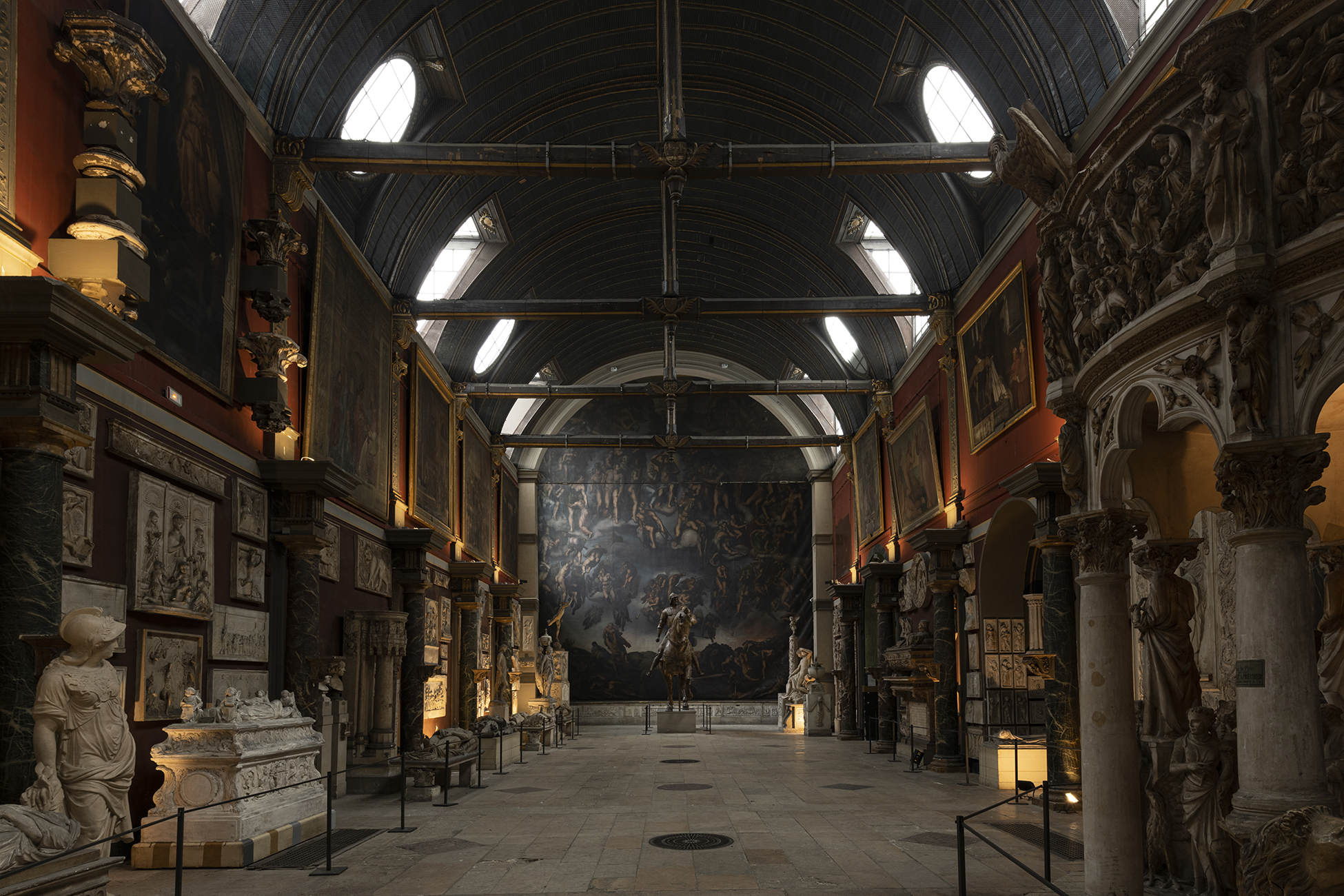
The chapel known as the ‘Chapel of Praise’, built for Queen Margot, and its adjoining buildings, erected in the early 17th century for the Petits-Augustins convent, are the school’s oldest structures. In 1790, Alexandre Lenoir (1761–1839), a curator, established the Musée des Monuments français there, where he preserved remarkable sculptural elements from monuments across France, which were at risk following their nationalisation by the revolutionaries.
In 1816, the Restoration led to the museum’s closure. The religious works were then returned to the churches; some original monuments were reinstalled (such as the tombs of the kings in the Basilica of Saint-Denis), whilst others were sent to the Louvre or left in situ. It was then that the premises were allocated to the École des Beaux-Arts, which has occupied its current site since 1829.
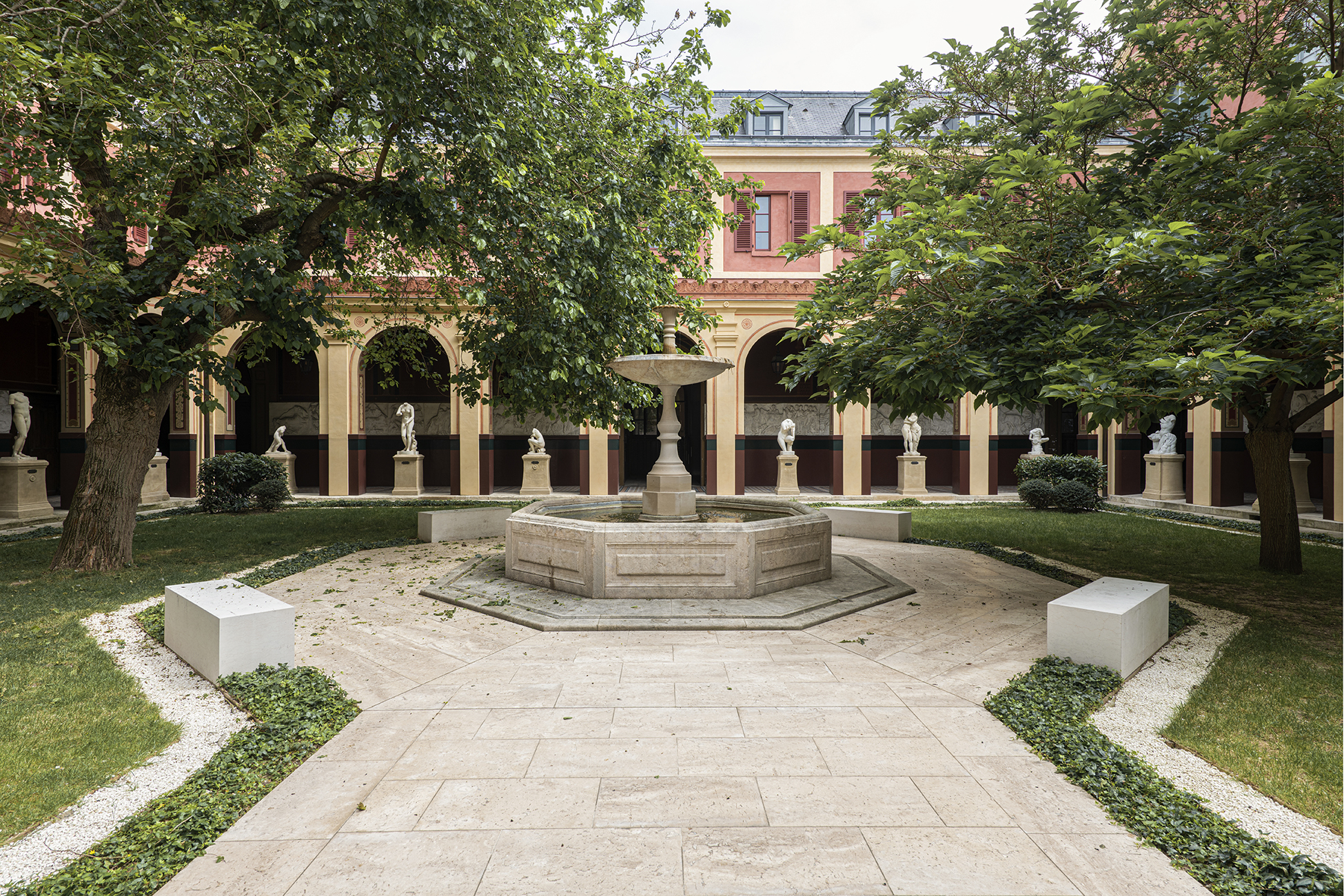
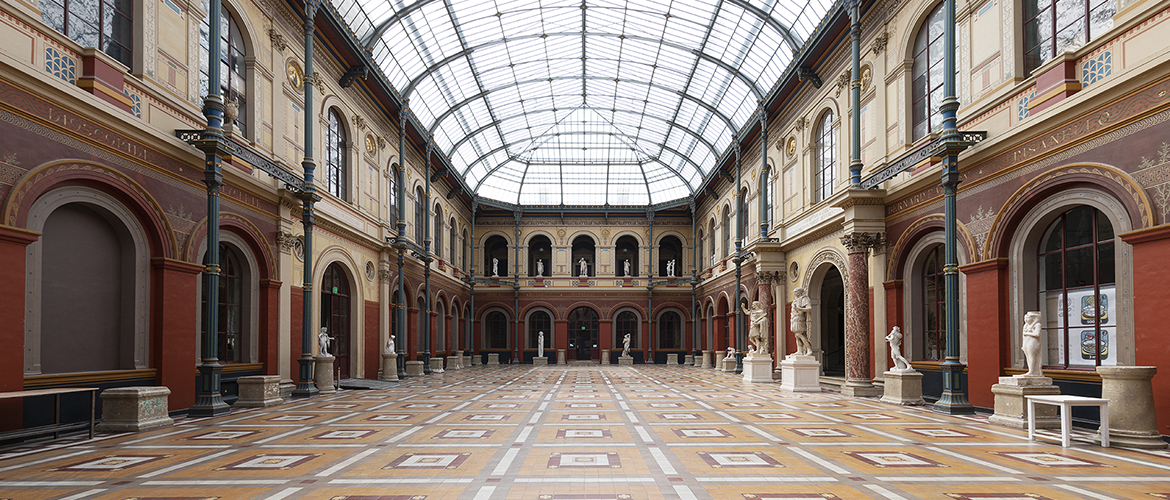
The establishment of the School gave rise to an ambitious architectural project, led by the architect François Debret (1777–1850). He commissioned the construction of the ‘Bâtiment des Loges’ to house the competitive examinations, and designed the ‘Palais des Études’, which was completed by Félix Duban (1797–1872), his pupil and brother-in-law. Duban completed the construction and decoration of this Palais according to his own vision and, as a complement, had an exhibition building erected (comprising the Melpomène and Foch rooms) overlooking the Quai Malaquais. Finally, he redesigned the entrance courtyards on the Rue Bonaparte side, as well as the chapel and cloister – now known as the Cour du Mûrier – of the former convent.
Inspired by Lenoir’s Musée des Monuments français, Félix Duban brought together architectural and decorative remains left on the site after the collections had been dispersed. He created a unique ensemble in which the reuse of fragments from various sources formed part of a coherent project: to make the School itself a teaching tool, offering everyone a free, intuitive and progressive discovery of art forms and art history.
It was in 1885 that the School underwent its major expansion with the purchase of the Hôtel de Chimay and its 17th- and 18th-century annexes, situated at 15 and 17 Quai Malaquais.
In 1954, in order to increase the number of studios, the exhibition halls were raised by the Perret brothers’ firm, giving the École des Beaux-Arts de Paris its definitive form.
Status and legal framework
A national public administrative body, governed by Decree No. 84–968 of 26 October 1984, as amended, the École nationale supérieure des beaux-arts falls under the supervision of the Ministry of Culture.
The Board of Governors, whose votes are binding, sets the institution’s strategic direction and approves the budget.
The Academic Council, chaired by the Director, is consulted on matters relating to teaching. Its opinions are advisory. It meets at least twice a year. In addition to the Director, the Academic Council comprises two figures appointed by the Director, fifteen elected teaching staff members from the institution, and three student representatives. The Order of 20 November 2020 sets out the organisation of admissions and studies at the School. It is supplemented each year by the regulations governing studies and examinations. The internal regulations specify the conditions under which the institution operates, particularly with regard to logistics and security. Every student admitted to the School receives a copy of these two sets of regulations and acknowledges that they have read and understood them.
Head photo: © Jean-Baptiste Monteil